
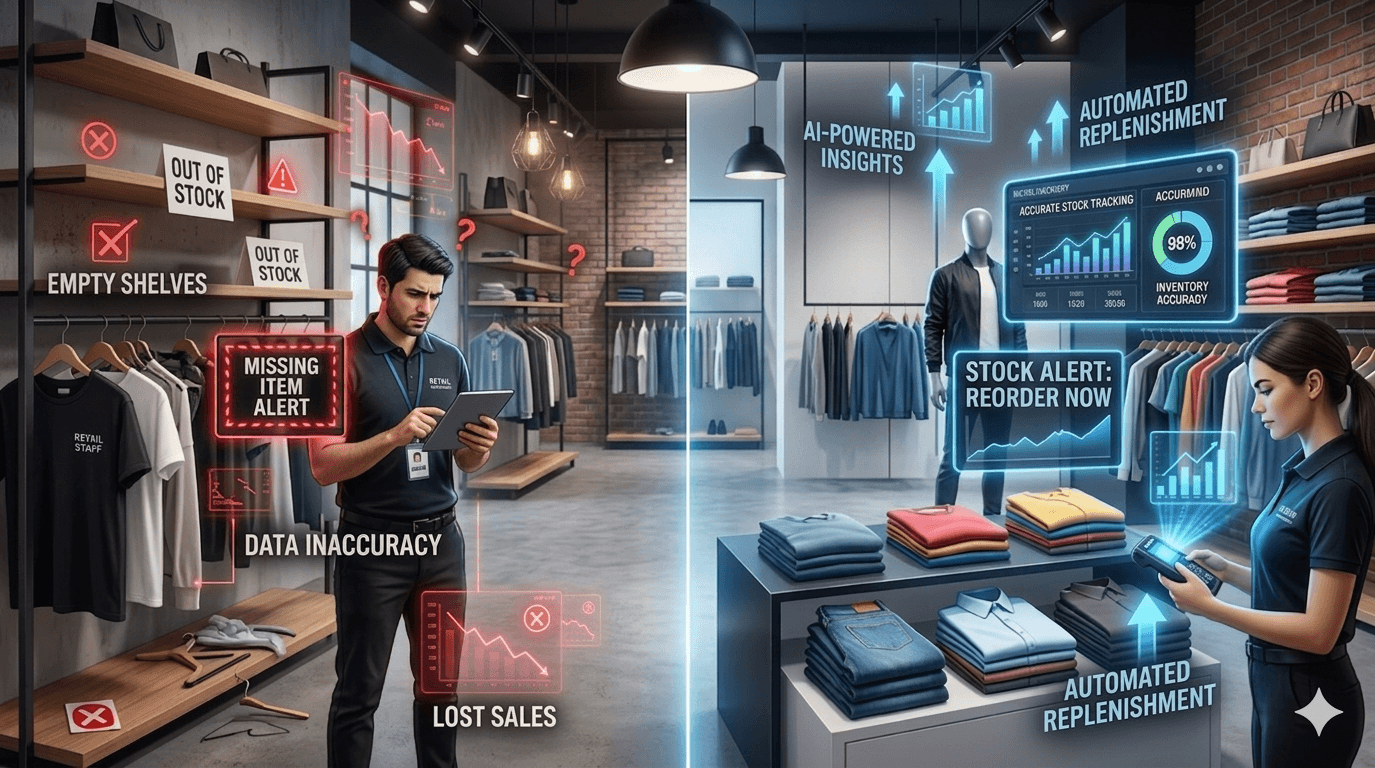
How many sales did you lose last month because your stock records didn't match reality?
Unlike many retail categories where one product has only a few variations, In Apparel & Fashion single shirt may come in multiple sizes, colors, fits, sleeve types, and patterns.
Even when stock is inside the store, locating the exact item at the right moment becomes difficult.
Your every out-of-stock moment hands your customer straight to your competitor.
- Problem: The system records a fabric roll or garment as in stock but it was misplaced, stolen, or damaged. Customers order online and face cancellations, damaging trust and increasing customer service load.
- AI Solution: Computer vision + RFID reconciliation algorithms continuously audit physical vs. system stock. Discrepancies are flagged and corrected within minutes — before a customer is affected. Impact: Reduces order cancellations by up to 35%.
- Problem: During festivals or events, demand often rises faster than expected. Without clear stock visibility, popular fabrics may sell out sooner than planned, creating missed sales opportunities.
- AI Solution: AI demand forecasting models trained on 3+ years of sales history, regional trends, and festival calendars generate replenishment alerts 4–6 weeks before peak demand arrives. Impact: Up to 40% fewer stockout events during peak periods.
- Problem: Buyers overestimate demand for certain colours or prints. Stock sits for 6–12 months, depreciating and occupying shelf space needed for fast movers, tying up working capital.
- AI Solution: ML models analyse sell-through rates and flag items at risk of becoming dead stock within 30 days, triggering automated promotions, markdowns, or bundle suggestions. Impact: Capital freed from dead stock can represent 15–20% of total inventory value.
- Problem: Each store buys independently. One branch holds 100 Jeans while a nearby branch is completely out of Jeans and turning away walk-in customers.
- AI Solution: A centralised AI inventory engine monitors stock levels across all branches and suggests cost-effective inter-store transfers or emergency replenishments between locations. Impact: Reduces lost sales from imbalance by up to 25%. Lowers over-purchasing costs.
- Problem: Traditional reorder points are set manually and rarely updated. They don't account for trend shifts, sudden demand spikes, or supplier lead time changes — causing both overstock and understock.
- AI Solution: AI continuously recalculates safety stock and reorder quantities using live sales velocity, supplier lead time data, and market trend feeds — adapting dynamically every day. Impact: Inventory holding costs drop by 10–18%. Fewer costly emergency orders.
- Problem: Textile SKUs explode in complexity — same fabric in 30 colours, 5 widths, printed or plain. Manual lookup is slow and error-prone, frustrating both staff and customers at the counter.
- AI Solution: Computer vision tags each bolt or roll by colour, pattern, and texture. Staff or customers can search by uploading a photo or describing what they need in natural language. Impact: Staff lookup time reduced by 60%. Customer satisfaction scores improve significantly.
- Problem: Suppliers in Surat or Tirupur face loom breakdowns, labour shortages, or shipping backlogs. Retailers find out about delays only when orders simply don't arrive — too late to act.
- AI Solution: AI aggregates supplier delivery history, news signals, and port logistics data to predict delay probability and automatically trigger alternate supplier or buffer stock alerts. Impact: Reduces supply disruption impact by 30–40%. Proactive rather than reactive response.
- Problem: When a bolt of fabric sells in-store, the website still shows it as available. A customer places an online order, payment is taken, then the order is cancelled — trust and revenue are both lost.
- AI Solution: AI-driven omnichannel inventory sync pushes stock updates to all selling channels within seconds of a transaction, preventing overselling across physical and digital touchpoints. Impact: Oversell cancellations drop by over 90%. Checkout conversion rates improve.
- Problem: Full stock takes require closing the store or working overnight, yet still produce 3–5% error rates. These errors cascade into wrong ordering, inaccurate reporting, and strained operations.
- AI Solution: Smart shelving with weight sensors, RFID tunnels, and overhead cameras run automated counts 24/7. AI reconciles data and flags variances automatically — no disruption to trading. Impact: Stock count accuracy improves to 99%+. Annual labour cost for counting reduced significantly.
- Problem: Static weekly reports show last week's numbers. The owner makes a buying decision on stale data — overbuys a fabric that has already started selling down, or misses an emerging bestseller entirely.
- AI Solution: AI-powered dashboards surface live sell-through rates, trending SKUs, and suggested actions — reorder, markdown, or transfer — in one view, updated every hour with plain-language insights. Impact: Decision-making speed improves 3–5x. Buyers act on signal, not noise.
Your competitor isn't beating you on price they're beating you on precision. Every phantom record, every stockout, every missed update may seem minor individually,
But together they silently reduce sales, frustrate customers, and weaken business growth.
The stores that win tomorrow are fixing these problems today.